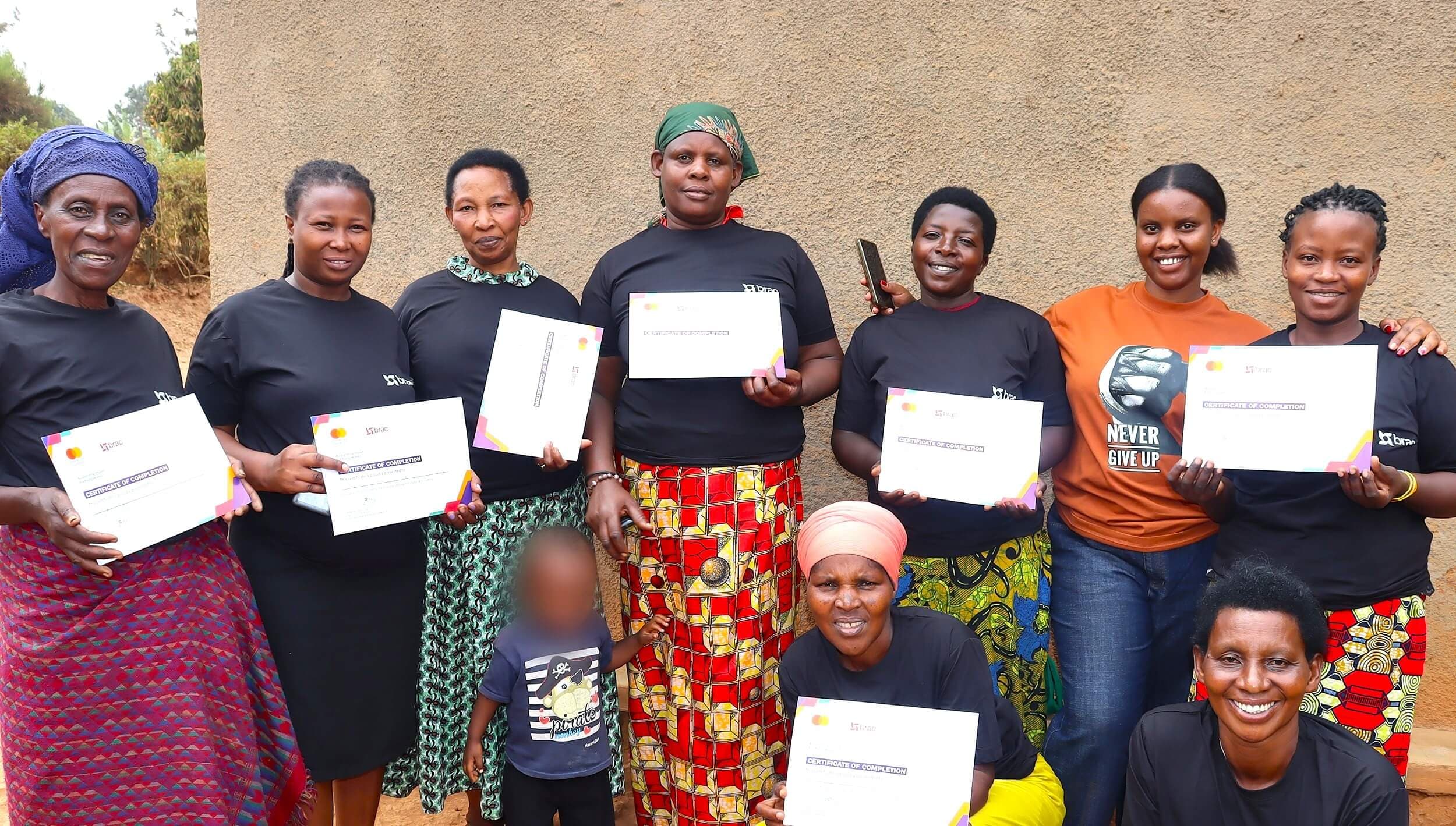
From Training to Transformation: BRMCP's FLT Programme, 2026
In February 2026, BRAC Rwanda Microfinance Company (BRMCP) rolled out its Financial, Digital and Life Skills Training (FLT) programme across all 34 branches. By June, 14,099 clients from 755 groups had taken part; 4,500 had completed it, including 2,915 who attended every single session. The rest are expected to finish by November 2026.
The training happens where clients already meet — not in classrooms — facilitated by Customer Service Officers (and by Credit Officers in five branches: Muhanga, Ruhango, Nyanza, Huye and Nyamagabe). Over four to five months, groups meet twice a week to cover four areas: well-being and sexual/reproductive health, financial literacy, digital literacy, and business development. The aim isn't just access to financial services, but the confidence and skills to use them well.
Since July, completing groups have held "FLT Day" graduations — not an endpoint, but a moment to reflect on what to sustain and to draw others in.
What is Financial Literacy Training Programme at BRAC
BRAC Financial, Digital and Life Skills Training (FLT) is a practical training programme that helps BRAC Microfinance clients build the knowledge and skills they need to manage their money, businesses and everyday lives better. The programme is implemented by BRAC Rwanda Microfinance Company in partnership with the Mastercard Foundation’s Accelerating Impact for Young Women (AIM) programme. This programme was launched in Rwanda in 2023, and since then over 40,000 BRAC microfinance clients have participated in it.
Through regular sessions held within their communities, mostly during group meetings, participants (MF clients) learn about saving and managing money, running a small business, using digital services safely, personal wellbeing, and making informed decisions for their families and businesses.
The programme is designed especially for women in low-income and rural communities, using simple and practical approaches that participants can easily understand and apply in their daily lives. In simple terms, FLT goes beyond providing financial services—it gives clients practical knowledge, skills and confidence to make better financial and life decisions.
Tamari's story
Tamari, a group-lending client from Runyinya in Gisagara, has traded agricultural produce for about 20 years. She joined BRAC after hearing it supported women, drawn especially by collateral-free loans repaid in small instalments. What surprised her most was that BRAC offered more than a loan — it offered learning.
Her group didn't miss a session, and by the end they wanted more. The training reshaped how she runs her business: "Before, I was doing business. Now, I plan my business." She now saves regularly, thinks through her investments, and understands her business's performance in a way she didn't before.
The change rippled outward. Her group grew from 17 to 25 members as participants brought others in. One friend, Jeanne, a Kitenge trader who used to rely on shop credit and struggled to track her finances, joined, learned to save, took a BRAC loan to buy stock directly, and brought order to her business. Neighbors began noticing Tamari's own visible progress and asking her secret; she pointed them to BRAC and the training itself.
Her closing advice to other women: build confidence in yourself and trust in institutions like BRAC, don't hesitate to raise problems with staff, and be deliberate about spending and saving.
The bigger picture
Tamari's experience is one of thousands from BRMCP's 2026 FLT rollout. The throughline: financial inclusion isn't just about reaching more clients with products — it's about building the knowledge and confidence that make those products actually work for people. The clearest sign of that, the piece argues, is when a client who came to learn starts teaching others — the point where training becomes empowerment, and inclusion starts reaching families and communities, not just individuals.